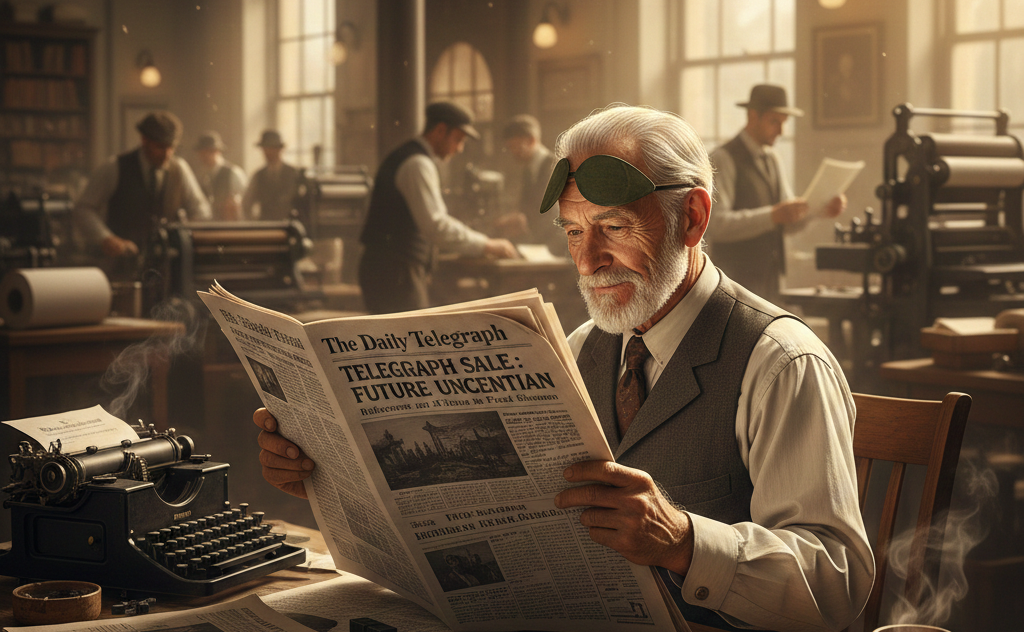
Is the Daily Telegraph sale a turning point for UK media? Today’s blog explores the history of the ‘Torygraph,’ the 2026 bidding war between DMGT and Dovid Efune, and why PR professionals must still care about legacy newspapers in a digital world.
In the world of UK media, few institutions carry the weight of The Daily Telegraph. Known affectionately (or otherwise) as the ‘Torygraph,’ it has been the broadsheet of record for the British establishment since the mid-19th century.
Today the story isn’t just in the paper, it’s about the paper.
After a years-long saga of debt, repossession and blocked foreign takeovers, the Telegraph is on the brink of a new era. In the age of TikTok and AI search, should we even care who owns a newspaper?
The answer is a resounding yes.
From Penny Press to Political Powerhouse
To understand why the current sale is so contentious, you have to look at where the Telegraph came from. Founded in 1855 by Colonel Arthur B. Sleigh, it started as a way for him to air a personal grievance against the Duke of Cambridge. It wasn’t a business success until Joseph Moses Levy took over and slashed the price to a penny.
It became the first penny press broadsheet, eventually outselling The Times. Over the decades, it evolved from a sensationalist reporter of crime and exploration into the definitive voice of centre-right Britain. It helped recruit codebreakers for Bletchley Park via its crossword and has famously served as the house journal of the Conservative Party.
When a brand has that much heritage and political stickiness, who owns it becomes a matter of national interest.
The Current State of Play
For the last few years, the Telegraph has been in a state of ownership limbo. After the Barclay family lost control due to unpaid debts to Lloyds Bank, we saw a dramatic tug-of-war.
A massive £600m bid from RedBird IMI (backed by the UAE) was essentially blocked by the UK government on the grounds of protecting free speech from foreign state influence. This led to a scramble for a suitable British buyer.
As of February 2026, the battle for the Telegraph has reached a fever pitch. Lord Rothermere’s DMGT (owners of the Daily Mail) recently struck a formal £500m agreement to acquire the titles, but the deal has hit a significant roadblock. The roadblock being a formal investigation by Culture Secretary Lisa Nandy.
Citing concerns over media plurality – specifically the fact that a DMGT-owned Telegraph would give one company control over more than 50% of the UK’s daily newspaper market – regulators are currently scrutinising the merger.
This delay has opened the door for a powerful rival bid. Dovid Efune, publisher of the New York Sun, has launched a aggressive counter-offer backed by a heavyweight consortium including Axel Springer (the German media giant behind Politico and Business Insider). Efune’s group is pitching themselves as the cleaner option, promising a deal with more upfront cash and fewer regulatory hurdles, setting the stage for a final showdown between traditional British press barons and modern, international media conglomerates.
Is This Still How We Get Our News?
You might argue that nobody reads papers anymore. While print circulation is certainly down, the influence of these titles is higher than ever.
A Telegraph exclusive at 10 PM tonight becomes the lead story on the BBC News at 6am tomorrow. It dictates the X (Twitter) discourse and feeds the algorithms of news aggregators.
In a world of AI-generated slop, readers are flocking back to trusted masts. The Telegraph has successfully pivoted to a high-value subscription model, proving that people will still pay for edited, verified perspective.
Why Should PR People Be Bothered?
If you’re in PR or marketing, the ownership of a major title changes the weather of your media landscape.
If the Telegraph merges its back-office or editorial functions with the Mail, the vibe of the paper changes. A story that might have landed as a thoughtful broadsheet piece might now be framed for a tabloid audience.
PR is built on relationships. When a paper changes hands, there is often a night of the long knives where editors and veteran columnists move on. If your ‘in’ at the Telegraph disappears, your media list just became obsolete.
For advertisers and consultants, we need to know that the platforms we recommend are stable and reputable. A paper owned by a foreign state carries different baggage for a client than one owned by a UK media mogul.
Why We Should Care
We should care because the Telegraph sale is a litmus test for the value of truth and influence in the 2020s.
It reminds us that even in a digital-first world, the old media still holds the keys to the kingdom. For us as consultants, it’s a reminder to never put all our eggs in the social media basket. Traditional media relations isn’t dead – it’s just getting more expensive and more politically charged.
Visit me on LinkedIn.
Read more of my blogs.
About Me
If you enjoy my blogs, you might be curious about my background. I’ve worked in PR and Marketing since 1993. Later, in 1999, I founded a full-service agency and spent the next 24 years successfully growing it. During that time, I had the privilege of partnering with some of the biggest blue-chip brands in the UK and learned extensively from the exceptional marketing professionals I met along the way. Then, in 2023, the management team I built successfully acquired my agency, 8848, setting me free to pursue new passions.
For the last five years, my love of marketing and communications powered our own family venture: a retreat of holiday cottages in the Peak District. I love making brands look and work better, and consequently, in just a few short years, we drove significant growth. In fact, thanks to my focus on SEO, we consistently ranked on page one for most key regional search terms, making 2025 our busiest year yet. We sold our venture in 2026, achieving a great return on investment.
Do you need help making your brand or business perform better? If so, I’d love to meet you. I’m based in Ashbourne, Derbyshire but work with companies across the UK and globally.